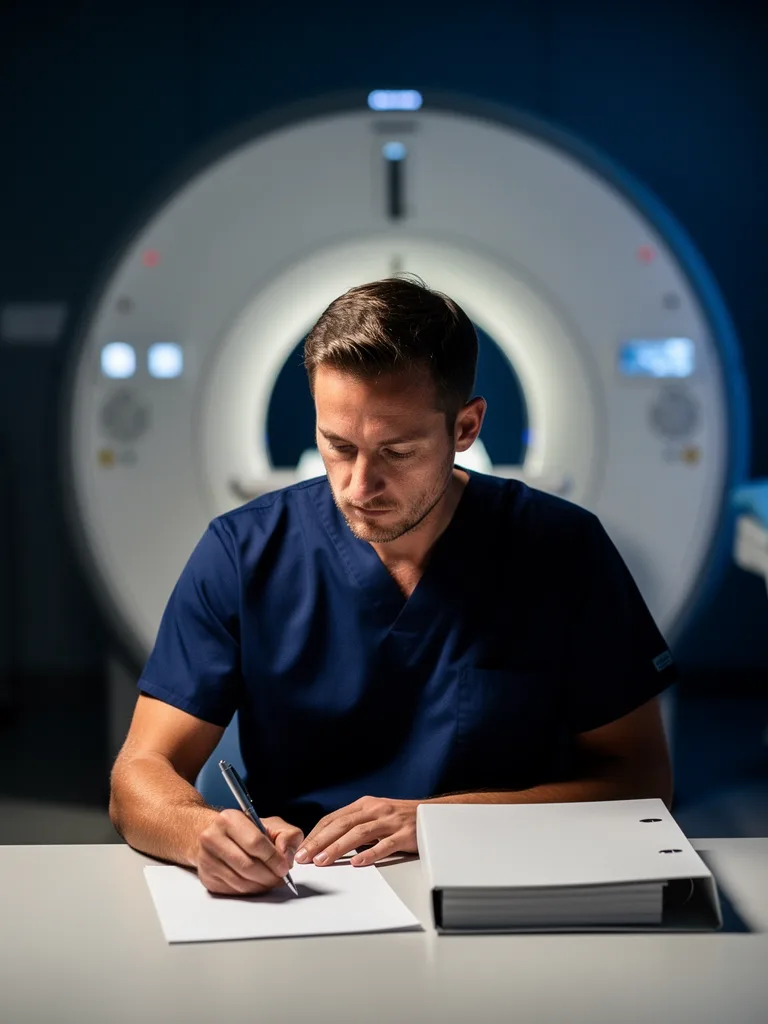
Computed Tomography (CT) Postprimary Exam — The American Registry of Radiologic Technologists
The ARRT Computed Tomography exam is the postprimary certification exam for radiologic technologists, nuclear medicine technologists and radiation therapists who perform CT scans. It covers patient care, safety, image production and CT procedures of the head, spine, musculoskeletal system, neck, chest, abdomen and pelvis. SummitCert's portal gives you explained practice questions, flashcards, a timed 165-question mock exam, a glossary and progress tracking built around the published ARRT content specifications.
One-time purchaseLifetime accessStudy on any deviceRefund policy
Everything included — in full detail
This is exactly what you unlock. No vague promises — real numbers, straight from the portal.
Your full practice pool — 350 questions total, written to mirror the real exam blueprint, with full answer explanations for every question.
Including Patient Interactions and Management, Radiation Safety and Dose, Image Formation, and more.
A complete, realistic exam-day simulation with the same question count and time limit as the real thing.
Covering every key term, concept, and framework you're expected to know.
Hand-picked walkthroughs and explainers organized by topic.
Visual breakdowns of the frameworks and models the exam tests you on.
The exact formulas and calculations you need, ready to review before test day.
A searchable glossary so unfamiliar terminology never slows you down.
See your accuracy by domain, spot weak areas early, and follow a built-in study schedule.
Tailored to this exam: it knows your progress and weak areas, remembers your earlier chats, and picks up where you left off on your other devices.
Study anywhere — your progress syncs on the device you are using and picks up where you left off.
No subscriptions, no renewals — buy once and keep studying until you pass.
See the ARRT CT portal
Real screenshots — this is exactly what you'll be studying in. Click to zoom in.
How would you like to start?
Try before you buy, or jump straight into full access.
Topics you'll drill
7 core topics pulled straight from the real question bank.
- Patient Interactions and Management
- Radiation Safety and Dose
- Image Formation
- Image Evaluation and Archiving
- Head, Spine, and Musculoskeletal
- Neck and Chest
- Abdomen and Pelvis
ARRT CT exam requirements & cost
Straight from the certifying body — separate from what we charge for the study portal.
The ARRT Computed Tomography content specifications list 165 scored questions in four categories: patient care, safety, image production and procedures. The exam also includes unscored pilot questions that ARRT uses to evaluate possible future questions; they do not affect the score. The procedures category covers head, spine and musculoskeletal, neck and chest, and abdomen and pelvis. ARRT revised the CT content specifications effective September 1, 2026; the number of scored questions in each section changed slightly and ARRT states that the total stays the same. The CT credential is earned through ARRT's postprimary eligibility pathway, which requires an existing ARRT credential in a supporting discipline. ARRT reports scores on a scale of 1 to 99, and a scaled score of 75 is passing. The percent score in the portal mock is only a self-check, not a prediction of your result. ARRT sets the exam fee and it can change, so confirm the current fee for this postprimary exam on the ARRT website. ARRT postprimary pathway: you must already hold ARRT certification and registration in a supporting discipline (Radiography, Nuclear Medicine Technology or Radiation Therapy), complete 16 hours of structured education aligned with the CT content specifications, and document the required CT clinical procedures, both within the 24 months before you apply. The portal is a practice aid built on the published outline: it is not a copy of the exam and it does not predict your score.
Real pass rate, retake policy, scoring, and a study timeline for ARRT CT — free, no purchase required.
Common questions
You might also need
Intraoperative technique, surgical anatomy, asepsis, and patient safety for the surgical first assistant.

Acute care across the adult-gerontology lifespan — board-style questions.

Oncology pharmacotherapy and patient management for the BCOP exam.
Contact lens fitting, dispensing and follow-up — practice for the ABO-NCLE Contact Lens Registry Examination (CLRE).
Organ and tissue procurement coordination — board-aligned questions.
5.0 (1)