
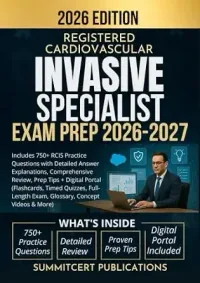
Registered Cardiovascular Invasive Specialist (RCIS)
The CCI Registered Cardiovascular Invasive Specialist (RCIS) exam assesses the knowledge needed to work in the cardiac catheterization lab, covering pre-procedural care, diagnostic and interventional procedures, hemodynamics, pharmacology, vascular access and emergency protocols. Many hospital cath labs require RCIS or an equivalent credential for invasive specializt roles. SummitCert's portal helps you prepare with procedure-focused practice questions and explanations, hemodynamic formulas, flashcards and a full-length timed mock exam.
5.0 · 1 ratingOne-time purchaseLifetime accessStudy on any deviceRefund policy
Everything included — in full detail
This is exactly what you unlock. No vague promises — real numbers, straight from the portal.
Your full practice pool — 470 questions total, written to mirror the real exam blueprint, with full answer explanations for every question.
Including Pharmacology — Antiplatelets & Anticoagulants, Interventional Cardiology — Devices & Techniques, Vascular Access & Complications, and more.
A complete, realistic exam-day simulation with the same question count and time limit as the real thing.
Covering every key term, concept, and framework you're expected to know.
Hand-picked walkthroughs and explainers organized by topic.
Visual breakdowns of the frameworks and models the exam tests you on.
The exact formulas and calculations you need, ready to review before test day.
A searchable glossary so unfamiliar terminology never slows you down.
Real field-reference and career reading picked for this profession — never more exam-prep.
See your accuracy by domain, spot weak areas early, and follow a built-in study schedule.
Tailored to this exam: it knows your progress and weak areas, remembers your earlier chats, and picks up where you left off on your other devices.
Study anywhere — your progress syncs on the device you are using and picks up where you left off.
No subscriptions, no renewals — buy once and keep studying until you pass.
See the RCIS portal
Real screenshots — this is exactly what you'll be studying in. Click to zoom in.
How would you like to start?
Try before you buy, or jump straight into full access.
Get the printed RCIS exam-prep guide — full digital portal access is included via the code inside.
Topics you'll drill
8 core topics pulled straight from the real question bank.
- Pharmacology — Antiplatelets & Anticoagulants
- Interventional Cardiology — Devices & Techniques
- Vascular Access & Complications
- Coronary Anatomy & Anomalies
- Coronary Physiology & Imaging
- Arrhythmia Management (ACLS)
- Cardiac Catheterization Fundamentals
- Hemodynamic Calculations & Physiology
RCIS exam requirements & cost
Straight from the certifying body — separate from what we charge for the study portal.
The RCIS credential is administered by Cardiovascular Credentialing International (CCI), and eligibility is met through one of three pathways: graduation from a programmatically accredited invasive cardiovascular technology program (no additional experience required); graduation from a related health-science program (cardiovascular technology, ultrasound, radiologic technology, respiratory therapy, nursing, or paramedic/EMT) plus one year of full-time invasive cardiovascular technology experience and 600 cardiac diagnostic/interventional procedures logged over your career; or graduation from a non-accredited invasive cardiovascular program plus a minimum of one year of specialty training and 800 clinical hours in the specialty. All pathways also require a high school diploma or GED. The exam fee is $365 USD, which includes a $100 non-refundable processing portion regardless of outcome. The exam itself is a 3-hour, computer-based test with 170 total questions (150 scored, 20 unscored pretest items) using a mix of traditional multiple-choice, multiple-response, hot-spot, and drag-and-place item types.
RCIS exam blueprint
Real domain weighting from the certifying body's own published exam syllabus.
- Diagnostic Procedures42%
- Interventional Procedures33%
- Pre-Procedural Activities10%
- Post-Procedural Activities9%
- Emergency Procedures & Protocols6%
Real pass rate, retake policy, scoring, and a study timeline for RCIS — free, no purchase required.
Customer reviews
Real reviews only — every one below is genuine, badged by who wrote it.
1 verified customer
This rating reflects Verified Purchase, Verified Gumroad and Verified Amazon ratings only. Team/editorial reviews (marked with a role, e.g. "Beta Tester") are sometimes shown for context but never counted here — that's by design, not a glitch.
Common questions
You might also need
Intraoperative technique, surgical anatomy, asepsis, and patient safety for the surgical first assistant.

Acute care across the adult-gerontology lifespan — board-style questions.

Oncology pharmacotherapy and patient management for the BCOP exam.

Contact lens fitting, dispensing and follow-up — practice for the ABO-NCLE Contact Lens Registry Examination (CLRE).
Organ and tissue procurement coordination — board-aligned questions.
5.0 (1)